

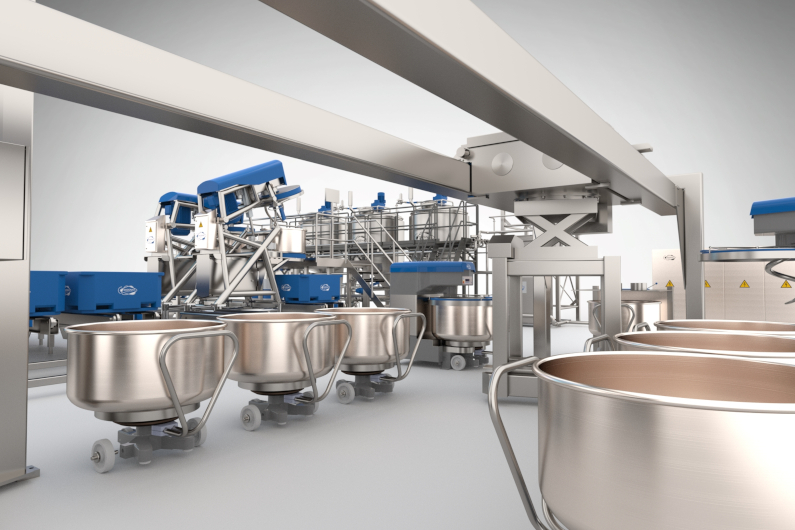
The consistency of perfectly formed dough depends entirely on the conditions during fermentation. DIOSNA develops pre-dough and dough fermentation systems that can ensure required parameters, with various degrees of automation.
The stakes are high for pre-dough to develop perfectly, as it has a direct impact on the texture, flavor and shelf-life of the final bread. Automation tools have a decisive contribution to this result, and making the equipment flexible enough to work with widely different types of dough is key. The most useful automation features DIOSNA incorporates in the design of its pre-dough systems help to easily control production. They also offer a high level of flexibility, allowing recipe customization based on specific products and requirements, and system capacity adjustments, via DIOSNA’s system control, according to the desired schedule.
Certain production stages can be performed by staff, when using a semi-automated system: the bowls can be handled manually. By reading their labels, the system will indicate on a display what route they need to follow between stations, from the dosing station to the kneader and lifting tipper, for example.
Spelt, wheat, organic pre-dough and more
DIOSNA’s pre-dough systems can flexibly work with different fermenters, including organic dough. The company explains how: “Depending on the dough quantities, our control system can switch the number of fermenters used for organic, respectively non-organic pre-doughs. This automated occupancy control will be connected to the customer’s production planning.”
Parameters can be set for each type of dough:
- Spelt flour – a ratio of flour/water of 100:100 is possible, along with temperature control, cooling, cold storage
- Wheat flour – flour/water ratio of 100:100 is possible, and temperature control, cooling, cold storage
- Rye flour – flour/water ratio of 100:110 is possible, and even 100:120, depending on the rye quality; temperature control, 3-stage fermentation option, cooling, cold storage
- Wholegrain Barley flour – flour/water ratio of 100:140
- (Whole) Rice flour fermentation – possible flour/water ratio: 100:150 up to 100:180
Several recent developments can be incorporated into DIOSNA’s dough resting systems. Depending on processing needs, they can range from multi-level solutions with an elevator, and automated tub or vat cleaning to process controls that allow the system to flexibly react to changing volume requirements. A recent dough resting automation project shows how such features come together: a Biga dough system was built over two stories, with a capacity of over 100 containers that can rest in a vast dough resting room, each holding over 120 kg of dough. However, smaller batch sizes also needed to be integrated regularly. DIOSNA’s solution: “After the resting time, the containers are automatically moved out from the resting room and are then transported following the first-in, first-out (FIFO) principle to a transfer station. Here, the containers are transported upwards and emptied into the stainless steel vats of a kneading system. The empty containers then move automatically to a cleaning station.” The elevator automatically handles the dough transfer to hoppers and conveyors.
Combining a lifting tipper and a vat transport solution bridges distance flexibly. The elevator, like the entire dough resting system, is controlled by the PLC. Automation stages Partially automated systems are a flexible solution.
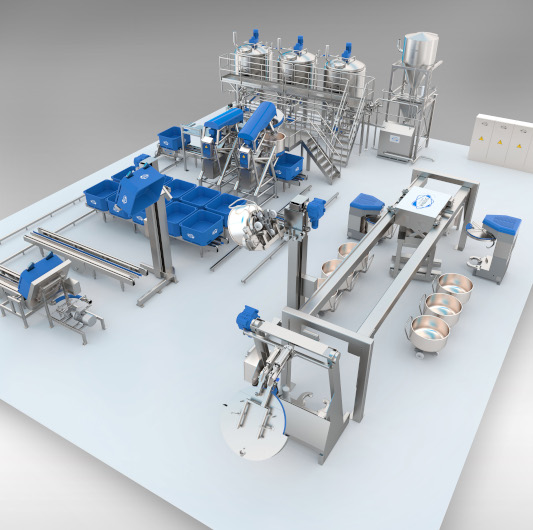 A number of processes can be performed manually – and can be gradually automated later – if needed for more efficiency, such as dosing, moving the bowls and cleaning. A fully automated, linear transport system offers the highest level of automation technology through a completely self-regulating process. It is essentially an individual solution for the bakery, designed for maximum flexibility. “A special feature of the linear transport system is the overhead guiderail, which ensures maximum ground clearance and best cleaning options. The DIOSNA linear transport system can include several dosing, mixing and/or emptying systems. This means that several recipes can be made simultaneously, in different mixers, to serve several subsequent lines with different volumes or equal amounts of dough,” DIOSNA elaborates. This system can be programmed with different dough resting periods, according to the recipes. Inside the system, an automated transport system handles the dough.
There are several options to program dosing and kneading on these flexible systems. The mixing energy is monitored throughout the process. The sequence of dosing and mixing processes can be programmed. The frequency control of the tools and bowls ensures individualized dough mixing. Once defined, mixing programs can be transferred between similar types of mixing systems. In addition, remote monitoring and remote service can be booked for this system, by defining a sequential step program. Each step can be programmed with a certain recipe functionality, such as kneading by time or energy, or dosing with/without kneading. Next, each function of a recipe can be optimized according to several parameters. The kneading program can contain up to 40 recipe steps. Automation features can be sequentially added over time.
One of the tools usually retrofitted is an IoT system. “Production monitoring is becoming increasingly important,” DIOSNA highlights. Data is a valuable asset in dough preparation: monitoring can show if production is still within the predefined parameters, it can detect errors, provide trend reports, and more. “Cloud-based solutions are also becoming increasingly interesting for production planning,” DIOSNA observes.
To integrate a pre-dough system into a production planning system, several aspects need to be considered. “It is not just individual devices, such as dosing units, mixers and conveyors that must be included in planning; they must also interact harmoniously. For optimum results, dough resting time must be taken into account,” DIOSNA underlines. A special feature of DIOSNA’s pre-dough system is the optimized process control for constant pre-dough quality. Such systems ensure the dough is ready for baking, and the end products will have the intended texture and flavor.
Photos: DIOSNA
The full article was published in Baking+Biscuit International, issue 4 – 2022.
