
Scroll Top
Big changes rely on big decisions
f2m-bbi-02-24-bakeries-bakery polen

At the beginning of 2024, the Polish industrial bakery NOWEL opened its new production facility near Warsaw. More than EUR 200 million is to be invested in the plant by the final expansion stage.

bbi: You produce frozen baked goods, some of which are non-branded products for baking stations, as well as ranges in the clean label, organic and artisan segments, where products are left to rest for more than 12 hours. You also make packaged goods for the end consumer market under the ‘Home Bakery’ brand. What and how much of this goes to the domestic market?
Elzbieta Zajezierska: A lot has happened in terms of production volumes since 2020. We now produce around 400 tonnes of baked goods every day. Of this, 70% goes to supermarkets, discounters and petrol stations throughout Poland. The remaining 30% goes to our partners in international markets. These are both basic products in our range – bread rolls, ciabattas, as well as premium bread with various ingredients, usually baked in a stone belt oven. A growing category – both in Poland and the rest of Europe – is snacks. Europeans have taken a liking to quick but tasty and healthy meals on the way to work or on the move. A sales hit in neighborhood shops or petrol stations in Poland are hot dogs, for which we also produce buns in various varieties and supply them to the largest chains operating in Europe. ‘Home Bakery’ was a short-term project that we launched in response to demand during the COVID-19 pandemic. We have already discontinued the concept.

bbi: You export to more than 30 countries. Were there any significant shifts in ranks during the pandemic? And what do exports look like today?

“We now produce around 400 tonnes of frozen baked goods every day. Of this, 70% goes to supermarkets, discounters and petrol stations throughout Poland. We supply the remaining     30 % to our partners in international markets.”

Elżbieta Zajezierska, President of the Board, NOWEL

Karolina Zajezierska: There have been several global events in recent years that have affected us as consumers and consequently all producers, not just food producers, had to adapt to these changes. The COVID-19 pandemic, the outbreak of the war in Ukraine, global inflation and economic challenges have significantly altered the capacity of consumers’ wallets, their approach to budget management and redefined their priorities. Today, Europeans are much more careful with their spending when shopping, including basic purchases such as bread. Compared to the past, they are more likely to choose to buy bread in a supermarket or a discounter because they appreciate its quality, and enjoy a very wide range of choices with a high degree of availability. Studies show that there is a large group of customers who have, until recently, bought their bread from smaller, artisan bakeries – which were often four to five times more expensive than their competitors – and who are now shifting their purchases in favor of retail chains. We see this as a horizontal shift in sales. This group of consumers is oriented towards price reduction.
On the other hand, we also see a vertical shift, which brings wealthy consumers who used to shop at high-end artisanal bakeries to look for everyday alternatives in the discounters. As a result, this makes the premium category in bake-off stations grow despite the general inflationary pressure. Another trend we are observing is that consumers can no longer afford as many luxury products as they used to and are therefore looking for pleasure in their food. Bread became one of the categories that lifted the consumer’s spirit, opening a wide path for product innovation. In other words, from the consumer’s point of view: “Maybe we cannot afford long-distance holidays as often as before; but, we can compensate for it with great, savory, crunchy, sourdough bread. And we can have it daily.”

bbi: At the beginning of this year, you opened your new production facility in Nowy Modlin near Warsaw. What will be produced there and for which markets?
Michał Zajezierski: We will continue with the bread range and products that have been successful in our current location. We will not, however, simply duplicate the existing technology, but, as always, strive for innovation and unique solutions. It is a bit of a paradox because, most of the time, in order to really make a difference on the market, you have to take risks with prototypes. Big changes require big decisions, but, at the same time, quality results from small, harmoniously coordinated details.

f2m-bbi-02-24-bakeries-NOWEL
About NOWEL Sp. z o.o.

NOWEL produces frozen bakery products (breads, small baked goods) for the bake-off sector at two plants in Legionowo (around 30 kilometers from the Polish capital Warsaw) and in Nowy Modlin (near Warsaw). In addition to leading Polish retailers, the wholesale baker supplies food retailers and discounters in other European countries such as the Netherlands, Germany, the Czech Republic and Hungary. Other export markets are the USA and Canada.
The export share is around 30 %. With around 500 employees, NOWEL generated sales of around PLN 247 million (approx. EUR 53.25 million) in 2020, making it one of the top five bakery companies in Poland, by its own estimation. In its domestic market, NOWEL is considered the market leader in the Kaiser roll and Wachau roll segment (stamped bread rolls) as well as in some mixed and wholemeal breads.
NOWEL is majority-owned by the Zajezierski family. The owner family includes Elżbieta Zajezierska (President of NOWEL Sp. z o.o., pictured in the middle above), Michał Zajezierski (Vice President) and Karolina Zajezierska (Commercial Director). The Polish investor Credit Value Investments (CVI) holds less than 30 %.

bbi: More than EUR 200 million will be invested in the plant over the coming years. What does the production facility look like today and what will the final expansion stage bring?
Michał Zajezierski: It is an ultra-modern bakery that will ultimately allow us to double our current production capacity and launch new products. We have planned the site in such a way that we will be able to commission additional production lines as required over the next few years. For us, it is a very important moment in the company’s development. We have been developing an existing plant for almost 15 years, making it one of the most modern in Europe. We have meticulously planned the new site from scratch, designing every element in such a way that our work will be even more efficient, safer and give us new possibilities in the future.

bbi: Inflation, wars and weakening purchasing power in many countries – is demand falling or shifting in the markets you serve? Is there pressure on prices? And, if so, how are you reacting to this?
Elzbieta Zajezierska: As already mentioned, we are observing both horizontal and vertical shifts in consumer behavior as a result of inflationary pressure. This translates into a growing demand for bake-off products. Some events influence the demand more abruptly but short-term (like the war in Ukraine) and some have more of a long-term effect, such as inflation. We appreciate that our main commercial partners, retail chains, try their best to keep the products as affordable as possible for the end consumer. And we have every intention of participating in that process. That is why we do our best to close long-term commodity contracts while, at the same time, leaving space for spot purchases that can help balance out the final price of the raw material. This difficult time has also shown us how important it is to work hand in hand with reliable partners on both ends of the process. Being challenged by the market so many times in the past years, all the participants understood that we really should work as one team. Looking for solutions together helps us to satisfy the end consumer, grow the business and support the economy in surviving the turmoil. However, unfortunately, this does not mean that the yearly negotiations have gotten any easier.

f2m-bbi-02-24-bakeries-bread

bbi: You now run two production sites. How is production distributed between the two sites? How much of it is bread, compared to small baked goods (such as bread rolls), and breakfast pastries such as croissants? What about pastries and cakes?
Michał Zajezierski: Currently, in both plants, we focus on bread products including rolls, breads, baguettes, premium products and hot dog buns. In Legionowo, we do not currently produce pastries, but we are not excluding this range from our future investments.

bbi: To what extent is the new plant already automated and digitized? What is the timetable for this?
Michał Zajezierski: Compared to Legionowo, we went even further with automatization in our new plant in Nowy Modlin. We have introduced a number of new solutions, particularly in the area of raw material supply, but also in production, that will result in even better quality products. Some of these solutions are unique for the bakery industry. NOWEL will be the first bakery to use them in industrial production.
As far as digitalization is concerned, the new plant will be supplied with a new, state-of-the-art, digital managing system, that will allow us to control every detail of our manufacturing process online, in real-time.

bbi: What is the status of the other plant, in this regard?
Michał Zajezierski: Our other plant in Legionowo is already highly automatized. We use fully automatic lines, which also feature automatized multi-step fermentation processes and robotized mixing solutions. In this regard, it is one of the most highly automated production facilities in Europe.

“At our new plant near Warsaw, we have introduced a number of new solutions, not only in the area of raw material supply, but also in production, that will result in even better quality products. Some of those solutions are unique for the bakery industry.”

Michał Zajezierski, Vice President of the Board, NOWEL

bbi: You want to create 800 new jobs in the new plant. Is it a problem to find qualified personnel for this?
Karolina Zajezierska: Ultimately, the new plant will have up to 800 employees. The recruitment of personnel for the first part of the investment started a few months ago. Nowadays, building and maintaining qualified teams is, obviously, a big challenge, not only in Poland. All of Europe is facing it. Today, a modern bakery is a place where every process is automated, digitized and only supervised by qualified staff. In our company, we have developed a system of staff training programs and skills development in various areas. NOWEL employs representatives of several generations of families. The oldest ones, who have been with us for more than 30 years, remember our beginnings in cooperation with retail chains, which were just starting to appear in Poland at that time. Their children have joined our company at a time when the processes were being automated. We believe that we can be an interesting alternative for many young people in the labor market. We combine tradition and craftsmanship with modernity and have 100 years of experience in this.

bbi: What can you tell us about energy efficiency and the issue of sustainability not only in regard to the new plant, but also the company as a whole?
Michał Zajezierski: Sustainability is one of the key drivers for our current operations and future development. The plant in Legionowo is already using multiple solutions that use recovered energy or heat in various processes. NOWEL is also in the process of building a solar power plant that will supply approximately 30% of the electrical energy needs for the Legionowo site. We draw the rest of our electricity requirements from a combined heat and power plant operated by the city of Legionowo, which supplies the city with thermal energy and hot water and delivers electricity to local companies, including NOWEL.
Our new plant was designed using all available technologies to lower its carbon footprint and prepare it to become carbon neutral. We will use heat pumps, solar power plants, electric trucks, and other solutions from the first day of the bakery’s operation. NOWEL is also cooperating closely with production line manufacturers on new developments that will make the production process more energy-efficient.

bbi: Until recently, you have primarily been a supplier to food retailers and the catering trade. At the end of the year 2022, you went directly to the end consumer market with two sales bistros in Warsaw. Will the bistros be operated by a separate company from NOWEL?
Karolina Zajezierska: The concept is formally part of the parent company NOWEL. It is merely another department in the company structure.

bbi: Can you tell us more about the idea behind this concept, will it remain limited to Poland? Or do you want to roll it out internationally, for example, in large cities or at the airports?
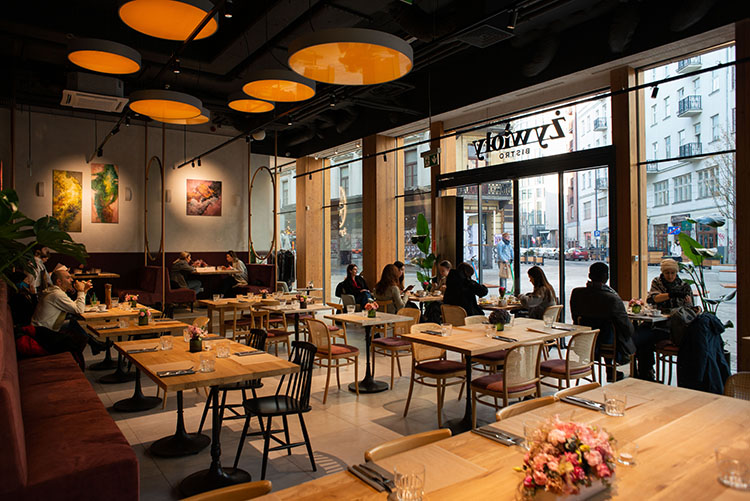
Karolina Zajezierska: In a way, history has come full circle. My great-grandfather, who started everything in our family bakery, was baking bread at night to sell early in the morning to neighbors and friends heading to work. This contact with people, relationships, conversations, hustle and bustle in our home bakery was significant and was engaging the next generations; thanks to this, we were able to grow. Now, we are returning to this atmosphere and direct contact with customers with our brand “Żywioły Bread&Bistro” (Elements Bread&Bistro). At the end of 2022, a flagship location was created in the center of Warsaw – in an iconic and well-known store, Dom Towarowy Braci Jabłkowskich (Jabłkowski Brothers Department Store).
It is a combination of a restaurant and a deli, and the so-called heart of our brand. A chef prepares seasonal dishes; you can enjoy time with family or friends, and buy fresh bread or sweets on the way out. At our second location, we bake bread and rolls on-site. There is also a large selection of sandwiches, cakes and snacks for sale. We are currently working on other locations in and around Warsaw. We want to open at least a few new bistros in 2024. It should become a nationwide concept. We are monitoring the market situation in Poland’s largest cities. That’s where we see the growth potential for our concept.

bbi: Could you give us a brief insight into the Polish bakery market? How is the market developing? How does it differ from the bakery markets in Western Europe, for example?
Karolina Zajezierska: Certainly, the Polish bakery market is comparable to the markets of Western Europe. Apart from local conditions resulting from culture or tradition, we see many similarities both in terms of consumer trends and leading categories. Poland’s baked goods market size is growing in value. According to Noble Fund, the size value of the frozen baked goods market in the country amounts to approximately PLN 3.5 billion. According to the Central Statistical Office (GUS), in 2022, the entire baked goods market in Poland was worth more than PLN 14 billion. Poles, like other Europeans, buy bakery products mainly in hyper- and supermarket chains. The share of frozen baked goods in total on the market is still quite smaller than, for example, in Germany or France; but, we predict that the share will grow year-on-year.
Still, not all retail chains in the country have invested in the frozen goods baking infrastructure, although it seems to be only a matter of time. As in the rest of Europe, consumer’s interest in premium baked goods has been growing in Poland in recent years. They are paying particular attention to the quality of raw materials, clean labels and taste. It is also an extremely competitive market because, historically, bread has always been perceived as cheap and affordable in Poland. That is why, in European statistics, the price per kilo of bread in Poland is one of the lowest in the region, even after inflation. Also, there are many good and reputable producers who operate on the market with large-scale production as well as thousands of medium-scale bakers, so one really needs to have a good strategy to grow.

f2m-bbi-02-24-bakeries-Żywioły

bbi: What about the competition from muesli, porridge, and the like?
Karolina Zajezierska: These products are, of course, competing for their place on the consumer’s table, but we prefer to focus on product development strategies that result in quality, for which demand is growing.

f2m-bbi-02-24-bakeries-Zakwas

bbi: Over the past 20 to 30 years, a number of industrial baked goods manufacturers have emerged in Poland, some as subsidiaries of international groups that primarily serve the export market. Who serves the Polish market today: the artisan sector or does the business primarily run via food retailers and therefore industrial manufacturers?
Karolina Zajezierska: Many good and reputable producers operate on the market with large-scale production and they mainly work with retailers, although some specialize in the HoReCa segment and also develop their individual distribution channels on the so-called traditional market – privately owned stores, smaller supermarkets, etc. Medium-
scale bakers also work as fresh distributors with some retailers, although their primary distribution goes through their own bakery outlets. The market, especially in large cities gives room for artisanal bakeries to thrive, but, they are usually single-point, local-scale businesses.

“The share of frozen baked goods in the total market in Poland is still smaller than, for example, in Germany or France, but we predict that it will grow year on year.”

Karolina Zajezierska, Vice President of the Board, NOWEL

f2m-bbi-02-24-bakeries-outdoor area

bbi: Are bakery products in Poland today mainly eaten at home or in the catering trade, in cafés, bistros, or fast food outlets?
Karolina Zajezierska: As a result of the pandemic, many Europeans have scaled back going out to restaurants or bars, in favor of eating at home. Many studies even speak of a ‘generation of hermits’ who, as a result of the COVID-19 pandemic, have been holed up at home, work remotely, do most of their shopping online and use public transport less frequently. The service industry has certainly suffered from it, with far fewer users than before the pandemic.
In Poland, bread is a basic product. It is served at virtually every breakfast, dinner, as a snack, or as a nutritious meal at different points of sale.

f2m-bbi-02-24-bakeries-outside of the bakery